

The Wiest Family
Written by Denny Wiest
My mother and her sister both passed away from ALS in the mid-1990s. Their two siblings and my maternal grandparents are not known to have shown signs of ALS. I did not know then that the ALS in our family might be hereditary.
For the next three decades, I never considered the possibility that I might carry an ALS gene mutation. My life followed a familiar path: college, career, marriage, home ownership, four children, and then the joy of watching our adult children begin building lives and families of their own.
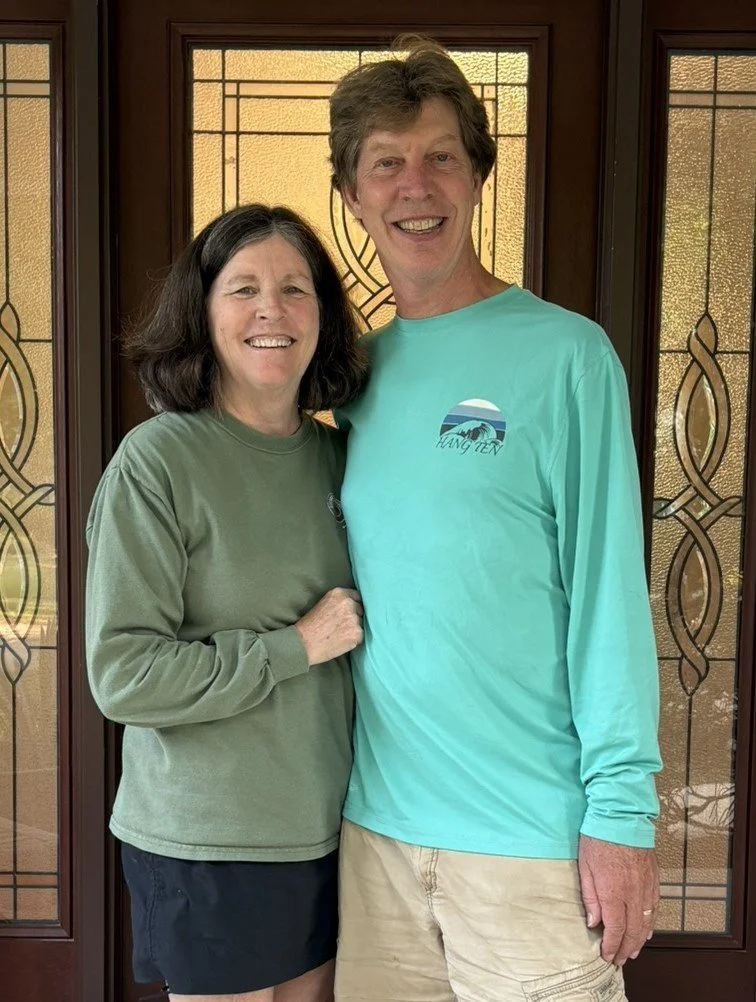
Denny and Colleen Wiest
ALS knocked on my door in 2024. Genetic testing confirmed that I carried the CHCHD10 R15L mutation after I learned that two of my siblings had been diagnosed with ALS several months earlier and carried the same mutation. Looking back, I realized that I had noticed weakness in my left arm about a year before my diagnosis. I was fortunate to be diagnosed at a relatively early stage of ALS, and I doubt I would have been tested as soon as I was if my siblings had not shared their diagnoses with me.
The remainder of 2024 was challenging for my wife, Colleen, and me. Being diagnosed with a disease for which there is currently no cure is difficult enough. Learning that each of our children had a 50% chance of inheriting the mutation (and knowing that it could continue into future generations) was even harder to absorb. One of the most difficult days of our lives was telling our adult children about my ALS diagnosis and what it could mean for our family.
At the time of my diagnosis, there was very little information available about the CHCHD10 mutation. Later in 2024, however, a significant ray of hope emerged for our family. Through our own research, we learned about the work being done by Columbia University Irving Medical Center and the n-Lorem Foundation to develop antisense oligonucleotide, or ASO, medicines for people with extremely rare genetic diseases. CHCHD10 was among the genes listed with an available therapy.
It is difficult to describe the emotions of coming to terms with what ALS might mean for your family’s future and then, only months later, learning that an experimental therapy existed with the potential to reduce the harmful effects of the gene mutation. For the first time since my diagnosis, there was a possibility that treatment might slow the progression of my ALS, perhaps even halt it, and (if I were very fortunate and enough motor neurons could be protected) leave open the possibility of some future recovery.
For Colleen and me, that discovery changed everything. It gave us something we had not expected to have so soon after my diagnosis: HOPE.
We also discovered the NextGen ALS website (searching for CHCHD10 R15L) and learned about the extraordinary commitment the Weber family has made to advancing ALS research through advocacy, service, and fundraising. With the help of two of my sisters, we began researching our own genealogy and discovered that our family and the Weber family share common ancestors going back five generations.
That discovery gave NextGen ALS an even more personal meaning for us. We feel incredibly fortunate to have discovered our connection to the Weber family and grateful for the years of advocacy and support they have devoted to helping families affected by ALS.
As of September 2026, I have been a participant in the Columbia Silence ALS research program in New York City for one year and have completed my sixth ASO treatment, with treatments now scheduled every three months. My ALS symptoms remain limited to mild weakness in both arms. Wanting to track my ALS progression as objectively as possible, I have spent the past year going to a gym several times per week, performing careful upper-body exercises and keeping detailed records of the machine used, weight setting, repetitions, and sets. After a year of detailed record keeping, my strength measurements have remained remarkably stable. I plan to continue my exercise regimen and detailed record keeping for as long as I am able. While there are no guarantees with this ASO treatment program, I remain cautiously optimistic. If the stability I am experiencing proves to be a benefit from the ASO, what is happening today could offer real hope to future generations.
We move forward with HOPE!